
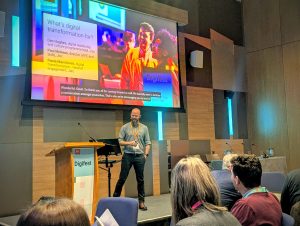
 On Day 1 at Digifest, we gathered a group of senior leaders and practitioners together to consider the question, “What’s digital transformation for?”
We started by sharing a definition of digital transformation that we use regularly at Jisc:
“Digital transformation is a series of deep and coordinated culture, workforce, and technology shifts that enable new educational and operating models and transform an institution’s business model, strategic directions, and value proposition.” EDUCAUSE, (my emphasis).
We considered the range of impacts of digital transformation and that digital shouldn’t drive change in and of itself but rather that digital should be used to solve problems that the organisation is facing. This stressed the importance of pursuing digital transformation to match the why of an organisation (why it exists) rather than the how (how it operates) which is what leads to the transformation of its business model, strategic direction, and value proposition.
In groups, participants then discussed what they thought their why was as organisations and many drew on the themes inclusivity, sustainability, and civic engagement, whether as anchor institutions or as contributing to the local economy through employability and skills provision.
A common thread in the discussions was the importance of the student or learner experience to ensure that they receive high quality teaching, learning, and assessment that appropriately draws on excellent research and the advancement of knowledge.

Teaching, learning, and academic practice
Primarily, groups recognised the possibilities that digital transformation brings for their educational models with increasing opportunities to create “just in time” provision for learners as well as greater personalisation to suit people’s different needs and preferences.
One group noted the potential to draw on artificial intelligence to create realistic scenarios for students to apply their learning within. Others considered how blended learning models better enabled learners to customise their learning to their context particularly in the context of commuter students and those who need to work alongside their studies.
Inclusivity and access
Many participants noted the potential of digital technology and transformation to increase inclusivity and accessibility to colleges and universities. They noted that digital education models could enable 24/7 access to teaching and learning which enables students and learners to engage with content on their own terms and the possibility of widening participation through a wider range of provision using digital resources.
At the same time, the groups recognised the importance of providing people with the right equipment and connectivity to be able to access these modes of delivery and the importance of designing learning experiences to recognise the tools that people are using.

Employability and skills
Participants noted that an important aspect of their why as organisations was to ensure that students and learners are equipped for the world of work and that digital transformation provides opportunities for universities and colleges to develop general digital skills and capabilities in their students as well as to prepare them to encounter new and emerging technologies.
One group particularly emphasised the contribution that colleges and universities make to their regions and the potential to prevent brain drain from communities by equipping people with the right knowledge and skills to remain in the area whilst working digitally. A number also noted how the moves towards lifelong learning will only increase this need, alongside the importance of accessible delivery routes for people at all stages of life and work.
Sustainability
Groups also reflected on the importance of digital transformation for the long-term sustainability of their organisations. People were aware of the importance of financial sustainability but not as an end in itself but also to ensure organisations continue to fulfil their wider social purpose and to maintain service quality within a challenging funding environment.
This was connected with being able to more effectively manage the wellbeing and workload of both staff and students, which led into conversations around increased efficiency and effectiveness. People recognised the potential of digital transformation to positively impact workload through unified systems, the breaking down of silos, and appropriate automation.

So, what’s digital transformation for?
Looking at the contributions of the different groups, it was heartening to see universities and colleges ultimately concluding that what digital transformation is for is really the people that further and higher education serves. That can be through new educational models that enrich the student experience and enable those who can’t currently access these pathways to participate in them. It can also be through increasing the sustainability of organisations whether financially, environmentally, or socially in improved working practices. Finally, it can be through the wider impact that universities and colleges have on society whether in the learning opportunities they provide, the research they pursue, or the jobs they provide directly or enable through the development of skills and capability.
If you’re looking to get started with digital transformation then for colleges and FE organisations we’d recommend reading Elevating digital transformation in further education: a guide for senior leaders and starting with Jisc’s Digital Elevation Tool.
For univerisities and HE institutions we’d recommend reading How to approach digital transformation in higher education and exploring Taking digital transformation forward in your organisation.