

Last month, I wrote about our plans to make better use of the knowledge shared in our monthly digital leadership and culture forum drop-ins. They bring together colleagues from across HE and FE to exchange ideas, surface challenges and swap solutions. In just an hour, participants choose what to focus on, and the conversation unfolds from there.
While the conversations themselves are valuable in the moment, we also wanted to capture the collective knowledge that surfaces. Using session summaries and notes from Miro, we’re building a knowledge trail: a simple record of each theme, takeaway, and any useful resources. Looking back across the year, certain themes have become clearer.
AI dominates, but perspectives are shifting
Artificial intelligence was a constant presence across the year. Early discussions focused on regulation, assessment, and integrity, while later sessions highlighted “AI fatigue” and the strain of constant change. Most recently, attention has turned to ethics with concerns about sustainability, bias, and the importance of keeping AI human-centred.
AI remains a dominant theme, but the conversation is clearly evolving. Participants are moving beyond interest in the tools themselves to deeper questions about what responsible, sustainable use looks like.
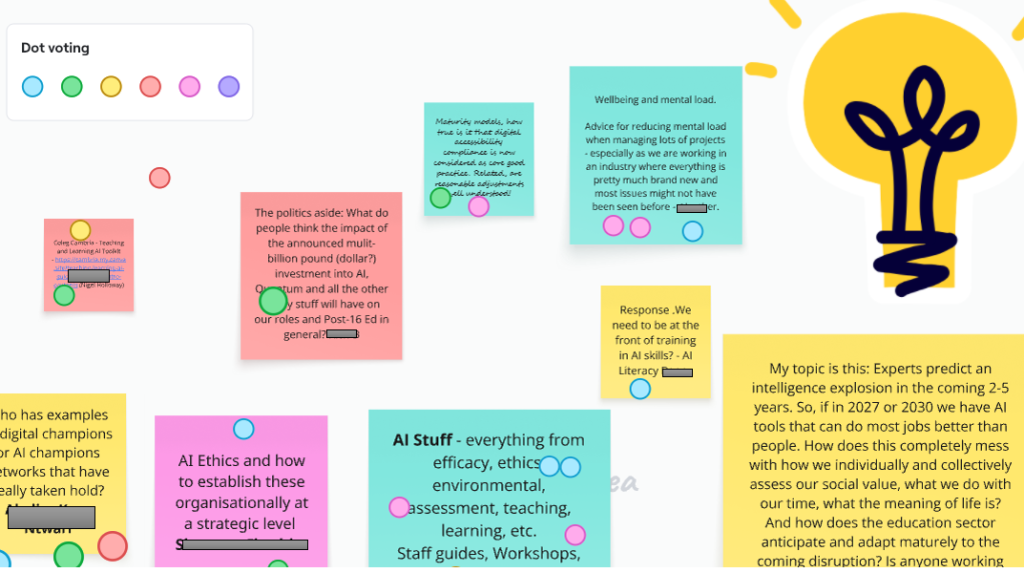 Topic voting on a Miro board during a drop-in session.
Leadership and strategy underpin everything
From organisational change to digital strategy and communication, leadership issues ran through many discussions. While less visible than AI, these concerns reveal the ongoing challenge of steering institutions through uncertainty and transformation. The recurring question was not just what technologies we adopt, but how we lead effectively while doing so. Leaders spoke about the pressures of carrying multiple priorities and the need for clear communication to align staff behind a shared vision. Without this, even the best tools or initiatives risk stalling.
Accessibility is a steady undercurrent
Accessibility and inclusion cropped up regularly, though usually in the context of practical tools or strategies, whether voting methods in the sessions themselves, digital literacy work, or embedding accessibility in policy. It’s not always the headline theme, but it’s consistently present as part of effective digital practice. Some sessions highlighted inclusion tools within quality processes and the importance of designing digital spaces that work for everyone. Perhaps not always the loudest theme, but shaping how digital transformation is experienced.
New themes beginning to emerge
In the most recent drop-ins, wellbeing and workload have surfaced as growing concerns. Participants spoke about the mental load of carrying multiple priorities, and shared strategies for lightening the burden. Digital champions also re-emerged as a model to spread support more widely. Could this signal a shift to more people-focused themes in the year ahead?
Why this matters
By looking back across the sessions, we can see that our community isn’t just reacting to trends, it’s tracing the deeper shifts that affect staff and students. AI remains the dominant thread, but issues of leadership, accessibility, and wellbeing remind us that transformation is as much about people as it is about technology.
We’ll continue to share summaries from each drop-in with our community, building this knowledge trail together. These sessions are a highlight of my month, and I’d like to thank everyone who has contributed. Your insights are shaping our collective understanding of digital leadership and culture across the sector.
